Salesforce Leads vs. Opportunities: What’s the Difference?
In this post, you’ll learn the difference between Salesforce leads vs. opportunities.
Salesforce research reveals that only 13% of leads turn into real opportunities. Do you know the difference between a lead and an opportunity and how to turn one into the other? Read on to learn more about leads and opportunities in Salesforce and how to convert those unqualified leads into qualified opportunities.
Short answer: In Salesforce, a lead is an unqualified prospect — someone who’s shown interest but isn’t yet verified as a real sales opportunity. An opportunity is a qualified, active deal with revenue potential. Converting a lead creates an account, a contact, and (when there’s a real deal) an opportunity.
Quick takeaways
- Lead = unqualified prospect. Opportunity = qualified, active deal.
- Converting a lead produces an account + contact, and an opportunity if a real deal exists.
- Keeping the two separate protects forecast accuracy.
- AI lead scoring now ranks leads by conversion likelihood — so reps work the right ones first.
Understanding the Lead Management Process in Salesforce
To understand the difference between leads and opportunities, you have to understand the lead management process in Salesforce. There is a logical progression from receiving a lead to closing a deal.
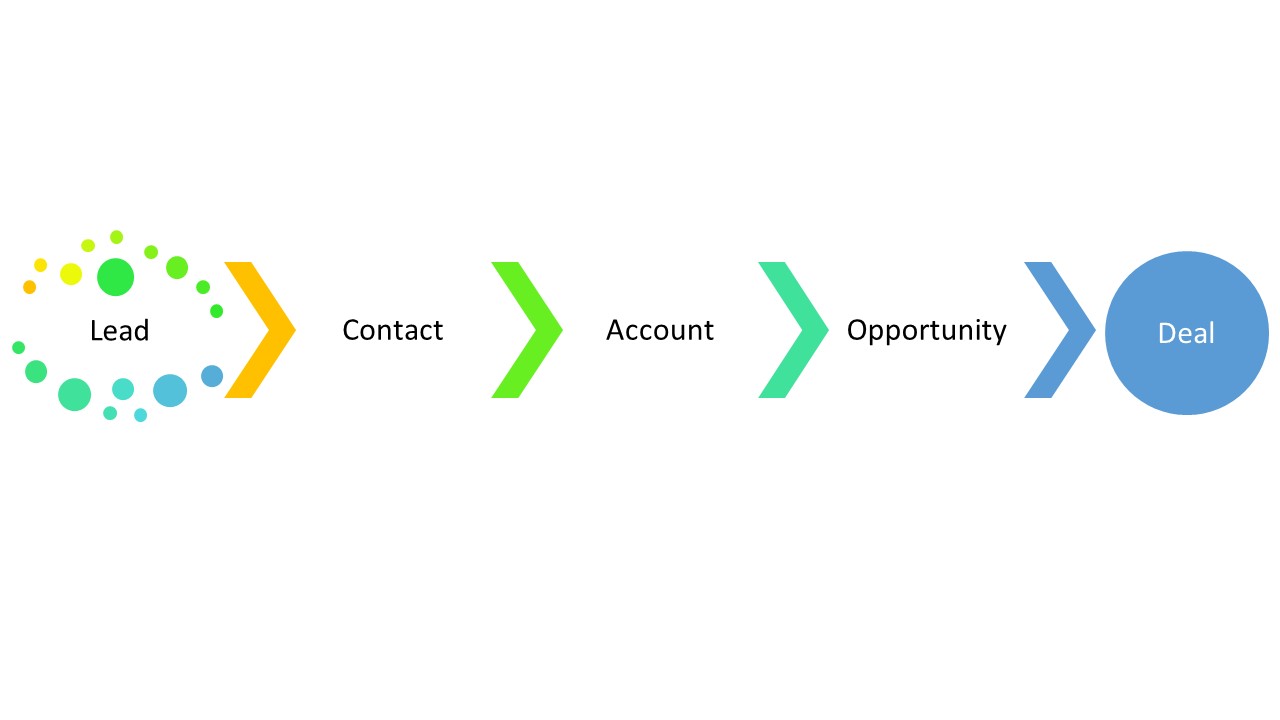
Salesforce lead management consists of four discrete steps, from lead to contact to account to opportunity, which then hopefully leads to a deal. As these terms are often misunderstood, we’ll look at each in more detail.
Lead
In Salesforce, a lead is an unqualified contact. This type of raw lead might lead to an opportunity or deal, or it might not – you just don’t know yet because you haven’t qualified the prospect. It’s just a name on a piece of paper or in a database, ready to be pursued.
Contact
Once you qualify a lead as a person who really could do business with you, that lead becomes a contact. A contact is someone interested enough in your business or product to warrant further interaction.
Account
An account isn’t a person, it’s an organization or business entity that you hope to sell to. There can be multiple contacts in each account – that is, multiple people for you to interact with.
Opportunity
An opportunity isn’t an individual or a business entity, it’s a potential future sale. Just as a lead can be converted into a contact or an account, contacts and accounts can be converted into opportunities when there is a high probability of closing a deal and generating revenue.
Deal
An opportunity is converted into a deal when that account decides to make a purchase from you. Closing the deal is the ultimate goal of the entire process.
Understanding Salesforce Leads vs. Opportunities
Many people confuse leads with opportunities. They are quite distinct within Salesforce, with one leading to the other.
Understanding a Salesforce Lead
A Salesforce lead can be any lead you’ve acquired from any source. Leads can come from:
- Click-through on online ads
- Contact information you’ve captured from your website
- Information entered in online quizzes
- Interactions on social media
- Incoming phone calls
- Referrals from existing customers
- Contact information submitted at trade shows
Not all leads, however, are equal. Some are more likely to lead to an opportunity or purchase, others not so much. This is why you need to qualify the leads you garner.
Understanding Lead Status
Salesforce’s lead qualification process lets you assign a status to each lead. There are four default statuses available within Salesforce:
- Open (entered into the system but not yet contacted)
- Contacted (initial contact has been made but nothing further)
- Qualified (contacted and interested in purchasing the product)
- Unqualified (contacted and deemed unlikely to ever purchase)
In addition, Salesforce allows you to create your own custom lead statuses.
Understanding a Salesforce Opportunity
An opportunity in Salesforce is not a lead, contact, or account. It’s terminology for a future sale by an account. That is, you have an opportunity for a sale.
You might think that qualified leads are likely to become opportunities. That can be true but isn’t always the case. Even if a qualified lead is interested in making a purchase, that purchase may not be imminent. (Marketing Donut reports that 63% of leads won’t convert for at least three months.) In short, a qualified lead has the potential to become an opportunity, but it isn’t a sure thing.
An opportunity, however, pretty much is a sure thing. It’s a deal ready to happen, and as such can be used to forecast your company’s sales.
Comparing Salesforce Leads vs. Opportunities
It’s important, then to understand the very clear differences between leads and opportunities in Salesforce.
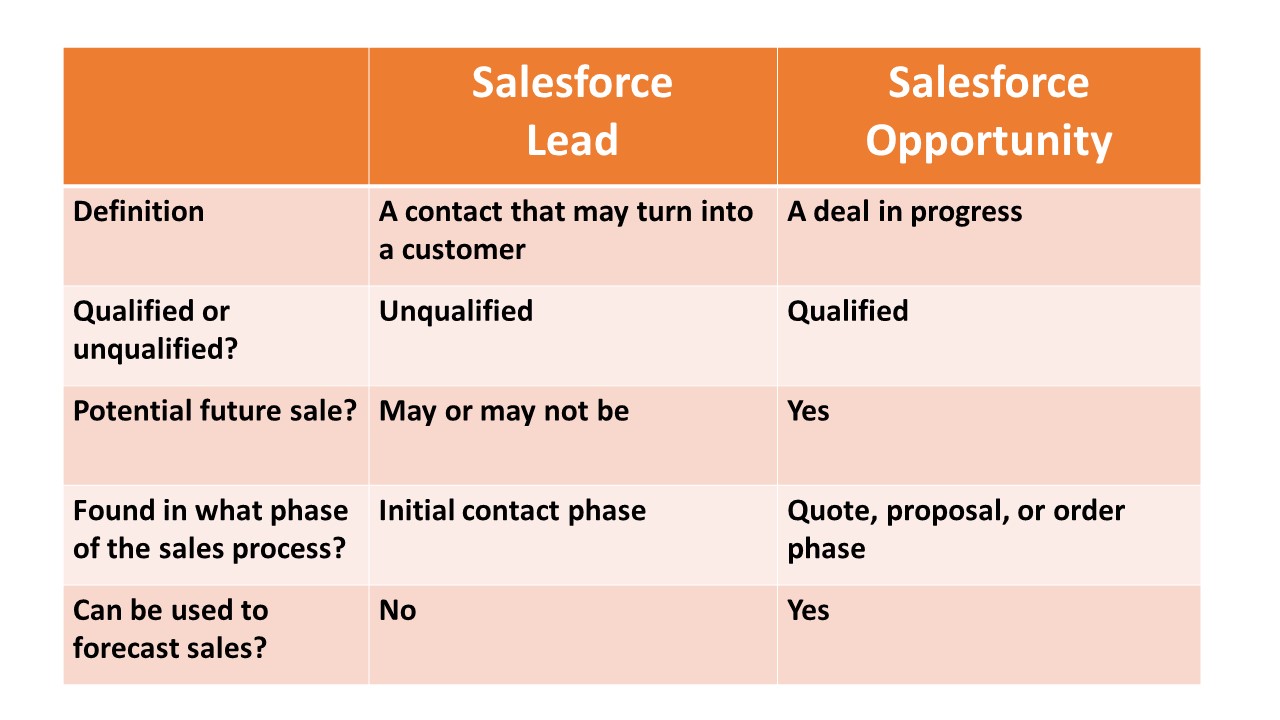
A lead is an unqualified contact that may turn into a customer. You find leads in the initial contact phase of the sales cycle, and they cannot be used to forecast future sales.
An opportunity is essentially a deal in progress. You find opportunities in the quote, proposal, and order phases of the sales cycle. You can and should use identified opportunities to forecast future sales.
Converting Leads into Opportunities
Within Salesforce, a lead can be converted into one of three types of items:
- Contact
- Account
- Opportunity
Converting a Lead
You should convert a lead into a contact or an account once that lead has been qualified. (Remember, you can assign multiple contacts to a single account.) You should convert a lead into an opportunity when that opportunity has clearly been identified, based on predetermined criteria.
The following video shows how to convert a lead into an account, a contact, or an opportunity in Salesforce.
Identifying an Opportunity
How do you identify an opportunity? That’s for an individual sales rep to determine, based on the following contact criteria:
- Product interest
- Budget
- Timeframe
Your company needs to establish guidelines for each of these criteria to determine whether a potential opportunity is legitimate or not. In general, an opportunity is more genuine if the lead exhibits strong product interest, has a purchasing timeframe in the near term, and has an identified budget for the purchase. Identifying an opportunity should be purely a data-driven decision.
Let Rainmaker Help You Turn Salesforce Leads into Opportunities – and Sales!
When you want to turn your leads into opportunities, turn to the Salesforce experts at Rainmaker. We can help you manage the lead generation and opportunity identification processes and maximize your revenues. We offer a wide variety of Salesforce Managed Services to help your company grow sales, improve customer service, and turn more leads into opportunities – and deals.
Contact Rainmaker today to learn more about Salesforce leads and opportunities!
Related Resources
Where AI changes the picture
The hard part was never the definitions — it’s deciding which leads deserve attention. AI lead scoring (Einstein and tools around it) now ranks leads by conversion likelihood using historical patterns, so reps spend time on the deals most likely to close instead of guessing.
But scoring is only as good as the data and the rules behind it — and that data spans Salesforce plus the tools around it. Deciding what runs inside Salesforce versus around it is the AI activation question → Want to see where AI could sharpen your pipeline? Take the free 19-question AI readiness assessment →
Frequently asked questions
What’s the difference between a lead and an opportunity in Salesforce?
A lead is an unqualified prospect who’s shown interest. An opportunity is a qualified, active deal with revenue potential and a sales stage.
What happens when you convert a lead in Salesforce?
Salesforce creates an account and a contact, and — if there’s a real deal — an opportunity. The original lead record is converted, not duplicated.
When should a lead become an opportunity?
Only once it’s qualified: there’s a genuine need, budget or buying intent, and a realistic path to a deal. Converting too early inflates the pipeline.
How does AI lead scoring work in Salesforce?
AI scores leads by conversion likelihood using historical win/loss patterns and engagement signals, so reps prioritize the leads most likely to close.